
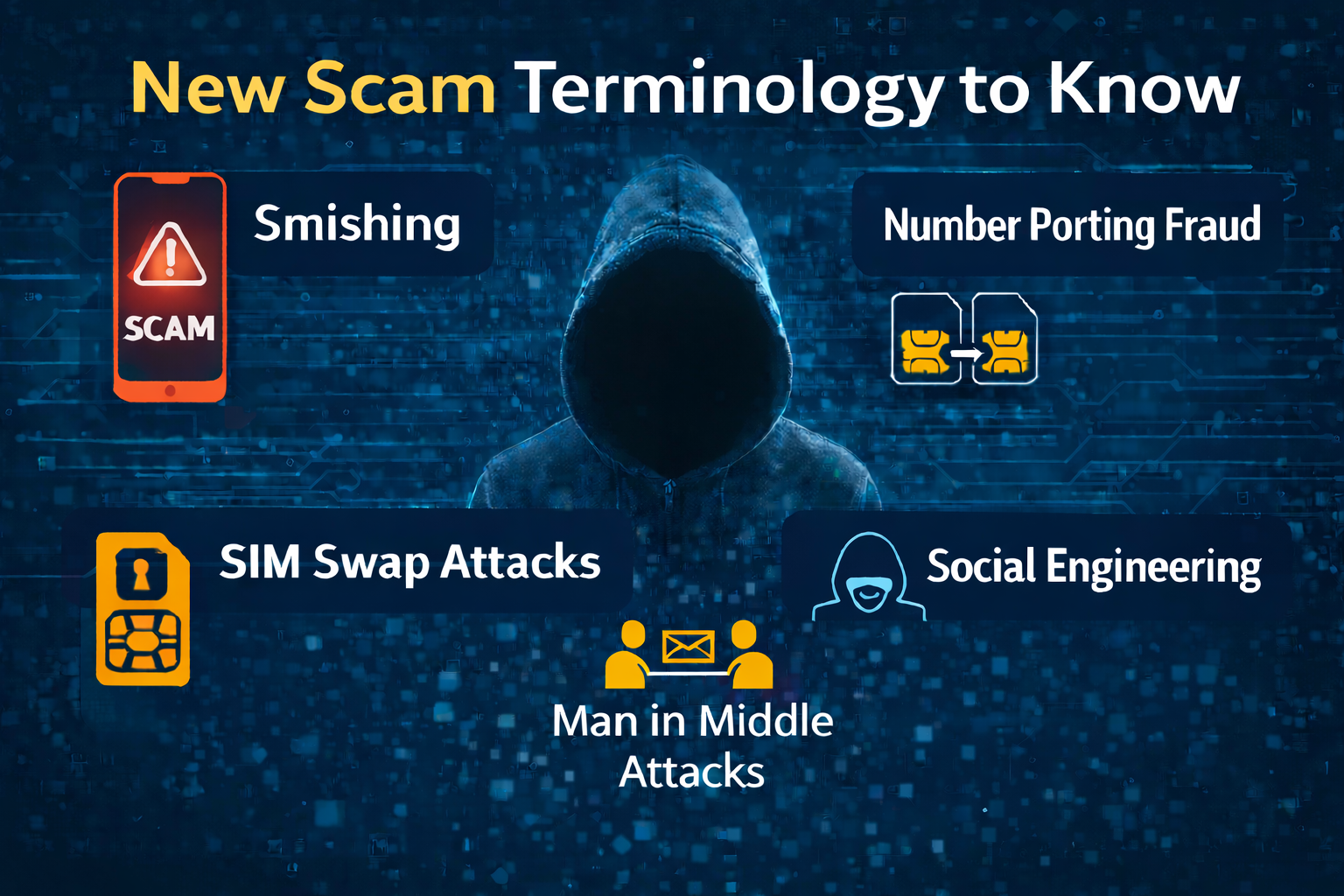
Cyber scams continue to evolve at a rapid pace. What once looked like obvious spam emails has become carefully crafted communication that feels personal, timely, and legitimate. Fraudsters now understand how people communicate, how technology verifies identity, and where digital security gaps still exist.
As scam tactics grow more sophisticated, so does the language used to describe them. New terms enter the conversation regularly, yet many people do not fully understand what they mean or how the scams work in practice. That lack of familiarity creates opportunity for criminals.
Understanding today’s scam landscape is not about fear. It is about preparation. Awareness gives you the ability to recognize red flags early and reduce the chance of becoming a victim.
Below are several scam tactics that continue to impact individuals, families, and public safety professionals, along with guidance on how to reduce risk.
Smishing
Smishing is phishing delivered through text messages. The term combines “SMS,” which refers to text messaging, with “phishing,” a tactic designed to trick individuals into revealing sensitive information.
Smishing messages often appear legitimate. They may claim to be from a bank, delivery service, utility provider, or government agency. Many attempt to create urgency by warning of suspicious activity, account issues, or missed deliveries that require immediate action.
Once a link is clicked or a reply is sent, the victim may be directed to a fraudulent website or prompted to provide personal information. This can include login credentials, financial details, or identifying data.
Because text messages feel informal and routine, people are more likely to respond quickly. Slowing down and verifying the source is one of the simplest ways to stop this type of scam.
Number Porting Fraud
Number porting allows you to change mobile carriers while keeping your existing phone number. It is a legitimate and widely used process, but it has become a frequent target for fraud.
In a number porting scam, a criminal impersonates you and requests that your phone number be transferred to a new carrier or device they control. If successful, your phone may suddenly lose service with little explanation.
Once your number is under their control, scammers can intercept calls and text messages, including one-time authentication codes. This can lead to rapid account takeovers across email, banking, and other platforms connected to your phone number.
SIM Swap Attacks
SIM swap attacks are closely related to porting fraud but involve your SIM card directly. A SIM card is the small chip that connects your phone to your mobile network.
In a SIM swap attack, a scammer convinces a mobile provider to activate your phone number on a SIM card they possess. This is often done using personal information gathered from data breaches, public records, or online profiles.
Once the swap occurs, calls and messages are routed to the attacker’s device. This allows them to reset passwords, intercept security codes, and disable protections before the victim realizes what has happened.
SIM swap attacks are especially damaging because they can undermine multiple security layers at once.
Social Engineering
Social engineering focuses on manipulating people rather than technology. Instead of hacking systems, scammers exploit trust, fear, urgency, or empathy.
A scammer may pose as a family member in distress, a coworker requesting urgent assistance, or a customer service representative seeking verification. These scenarios are designed to lower defenses and prompt quick responses.
Often, the details used are pulled from social media, public databases, or previous data leaks. Even small bits of accurate information can make a scam feel convincing.
When a request creates emotional pressure or demands immediate action, that is a strong signal to pause and verify the situation through a trusted channel.
Man in the Middle Attacks
A man in the middle attack occurs when a scammer secretly inserts themselves into a communication process.
A common example involves authentication codes. After obtaining a username and password, an attacker triggers a login attempt. The victim receives a security code, then receives a call or message from someone pretending to be the company requesting that code.
Once shared, the scammer can complete the login, change credentials, and lock the real user out of the account. Authentication codes are meant to protect access, but only if they remain private.
How Scammers Find Their Targets in the First Place
Many modern scams succeed long before the first text message or phone call is sent. In most cases, scammers are not guessing. They are researching.
Personal information is widely available online through people-search sites, data brokers, social media platforms, and public records. Names, phone numbers, home addresses, family connections, and employment details can often be pieced together with minimal effort. For law enforcement officers and their families, this exposure is often greater due to licensing requirements, public records, and media visibility.
Once scammers collect this information, they use it to build credibility. A text message feels more legitimate when it includes your name. A phone call feels more convincing when the caller references a family member, workplace, or recent activity. Even small details can make a scam feel real.
This is why awareness alone is not always enough. Recognizing scam tactics is critical, but reducing the amount of personal data available online helps stop scams earlier in the process.
At Privacy for Cops, we focus on minimizing digital exposure by removing online personal information from high-risk data broker sites. When scammers cannot easily find accurate contact details or personal connections, their ability to impersonate, manipulate, or intimidate is significantly reduced.
Scams thrive on access. Limiting that access changes the equation and shifts the balance back in your favor.
What to Do If You Are Targeted or Suspect a Scam
Even with awareness, scams can still happen. Knowing how to respond quickly can limit damage and restore control.
Stop engaging immediately
If something feels suspicious, do not reply, click links, or provide information. Scammers rely on continued interaction.
Secure your accounts
Change passwords on affected accounts right away, starting with email and financial platforms. Enable or review multi-factor authentication settings.
Contact your service providers
If you suspect a SIM swap or number porting issue, contact your mobile carrier immediately. Acting fast can prevent further account compromise.
Monitor financial activity
Review bank and credit card statements for unauthorized transactions. Consider placing a fraud alert or credit freeze if sensitive data may have been exposed.
Document the incident
Save messages, phone numbers, and timestamps. This information may be useful if you need to file reports or escalate the issue.
Reduce future exposure
Many scams succeed because personal information is easily accessible online. Removing exposed data makes impersonation significantly harder.
Why This Matters for Law Enforcement Families
Scams reach people through texts, calls, email, social media, and even traditional mail. For law enforcement officers, public officials, and their families, the risk is often higher due to increased visibility and publicly available personal information.
Education is one layer of protection. Reducing your digital footprint is another.
We help remove personal information from online databases and people-search sites, so scammers have less material to work with. When criminals cannot easily find addresses, phone numbers, or family connections, their ability to target and intimidate is reduced.
Cyber threats will continue to evolve, but preparation and proactive privacy protection can significantly lower risk.
Awareness helps you recognize scams. Online privacy protection helps stop them before they start. Learn how Privacy for Cops can help reduce your digital exposure and protect what matters most.
Exclusive Privacy Plans